
New Clutch Install (VTX 1800)
Posted by Bare | Last Updated March 19, 2015This is a walk-through for changing the clutch on the VTX 1800. I did this swap to the MTC clutch kit to stop clutch slipping on my friend’s bike. This is a simple job which requires a few basic tools and a torque wrench. As always undertake this project at your own risk, but with a little common sense this isn’t very hard to do.
Required tools/Materials
- New friction plates, whichever you choose – I used the MTC ones
- 7 steel clutch plates, OEM #22321-MAT-000
- 2 new exhaust gaskets
- 1 quart of cheap 10W-40 oil for soaking the new plates (make sure it is NOT energy-conserving)
- Black RTV silicone or “Hondabond” liquid gasket maker
- Torque wrench capable of 9 ft/lbs or 108 in/lbs
- 8mm and 10mm socket
- 5mm allen
- Roughly 14″ piece of wooden dowel rod
- Hammer
- Gasket scraper or razor blade
- If you’re not changing your oil at the same time then you’ll need some 2x lumber, bricks, etc to rest the bike on
- (Optional) B&B heavy duty clutch bolts
Process
Before you get started you need to soak the new clutch plates in oil. Any quart of cheap 10W-40 will suffice as you’re just using it to soak the plates and throwing it out (IMO there’s too much possibility of it getting dirty to want to reuse it). Make sure that the oil you get doesn’t have friction modifiers like Molybdenum (Moly) and you don’t want any oil stamped “energy conserving” as these additives cause clutch slippage. You can soak the plates in a bin (like an oil drain pan) or a Ziploc bag and pour the oil in with them. If you use the Ziploc I still recommend putting it in something in case the bag springs a leak. You don’t have to soak the steel plates as well but I do for good measure. You soak the plates so that when you finish and start the bike you’re not spinning a completely dry clutch against itself. Soaking the steel plates gives you a little more oil in there as insurance. The plates need to soak for at least an hour before installing them, but I prefer to soak them overnight before installation just to make sure the oil really works into the plates.
While the plates are soaking you can start working on the bike itself. First, remove your exhaust. This process is different from pipe to pipe so I’ll just say remove it – and don’t forget to remove the old exhaust gaskets too! Once your exhaust is off you’ll have to decide if you’re changing your oil now or not. If you’re changing your oil then drain the crankcase and leave it empty until afterwards. If you’re not changing the oil then put the front and rear tire on a 2x board or other roughly 2 inch block. I did mine by putting just the rear tire on 2 2×6’s but it’s up to you. With the bike on these blocks rest it on its sidestand. Trust me it’ll be fine.
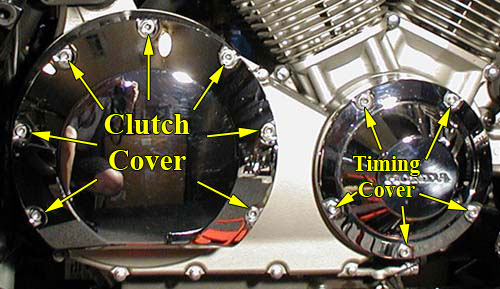
Now, looking at the bike from the right side, remove the seven 5mm allen bolts holding the clutch cover in place and the five 5mm allen bolts holding the timing cover in place. Remove both covers and set them aside in a safe place.
Be careful when you remove the clutch cover, there are 10 little rubber “thingies” that act as vibration dampeners for the cover. Sometimes they stick to the crankcase cover so you have to remove them and reinstall them where they go.
This is what they look like: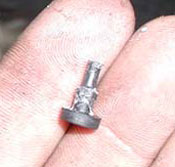
|
This is where they go: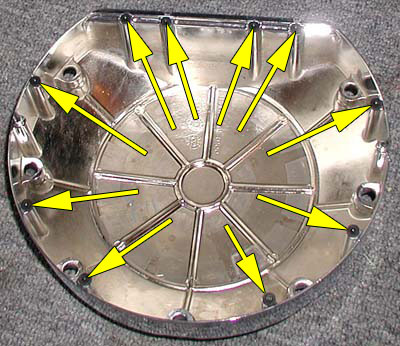
|
Remove the big rubber dampener from over the clutch cover and set it aside.
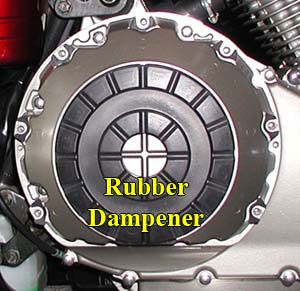
With the covers off it’s time to remove the right crankcase cover itself. This consists of 15 8mm bolts, you can see the locations labeled in this picture.
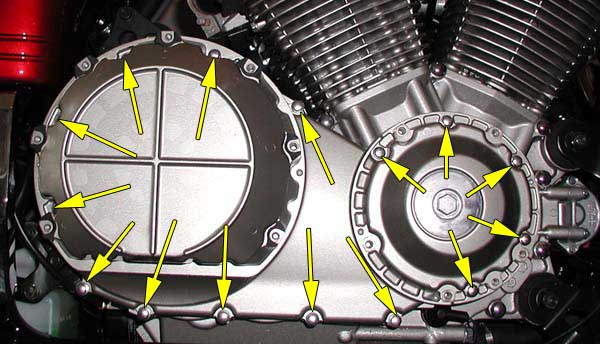
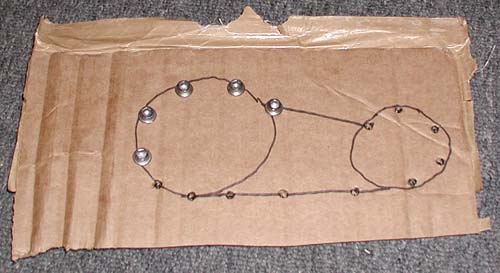
Now keep in mind, there are 3 different sizes of case bolts here, so to make this a little less complicated on reassembly I highly suggest something like this cardboard template for the case bolts.
This idea works great on anything with different sizes of bolts/screws where you need to remember exactly where they go. You can see the holes in mine, but many of the bolts were reinstalled already when the pic was snapped.
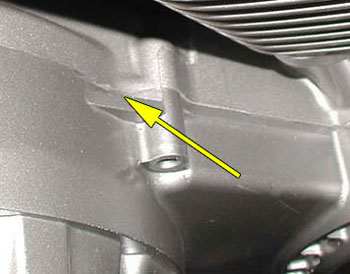
With all the case bolts removed take your hammer and wooden dowel, come from the left side of the bike behind the rear cylinder and slide the rod through until it touches the tab on the right side case (see pic). This picture was taken from the top of the engine looking down at the case where the timing and clutch “circles” meet the “flat” area on top the case.
With the dowel against that tab, a couple of light pops with the hammer should break the cover loose. Something else to keep in mind once the case is open is that the edges can be fairly sharp and I know a couple of guys who actually sliced themselves pretty good on them, so be careful! (Thanks to Bill Lage aka Wyandotte Kid for this pointer!)
|
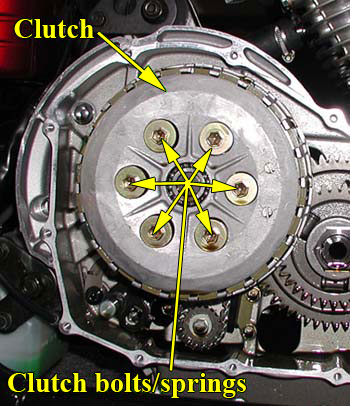
Under the cover:
|
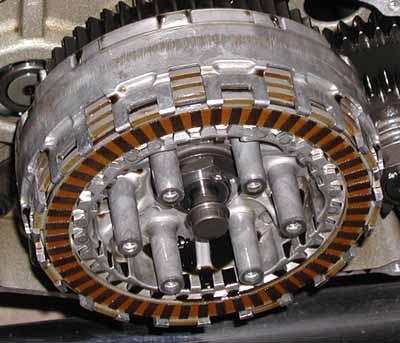
Remove all 6 of the clutch bolts and springs and set them aside. Bring each bolt up equally a few turns at a time to prevent loading too much pressure on just 1 or 2 bolts. If too much pressure is placed on a bolt it can be weakened and potentially fail during use. With the bolts and springs removed you should be able to remove the pressure plate (the plate the bolts and springs were in) and you’ll see something similar to the picture below. At this point the old clutch plates will just pull out. You can pull them out using a small screwdriver. If you have a small hooked pick, it will make the job easier. The plates will alternate one friction plate and one steel plate all the way to the back of the basket. You will remove 8 friction plates and 7 steel ones.
|
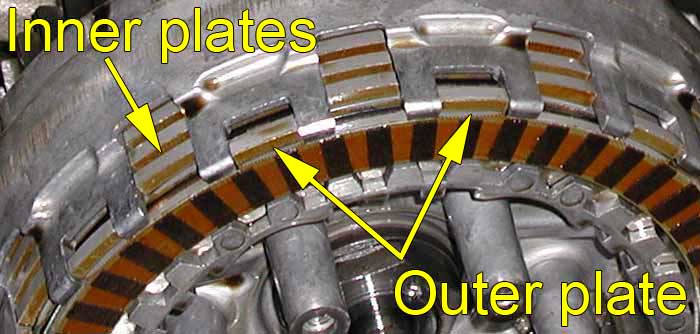
Now that the old clutch plates are out you can begin installing the new clutch plates. Look closely at the steel plates, many of these are made through a stamping process where they are punched out of sheet steel. The stamping process leaves a rounded edge and a sharp edge. When you begin installing the clutch plates you want to put the sharp edges to the inside. This is an old mechanics trick I picked up, the idea being that if the clutch may have trouble disengaging the rounded edge will be less likely to “catch” or “snag” anything in the clutch basket during disengagement. It’s not absolutely necessary, but it only takes an extra second to do it, so I do.
Begin installing the new clutch by putting a friction plate in first and then alternating steel/friction/steel/friction until you have 8 friction plates and 7 steel plates in. For every plate you install make sure to press it into place on top of the last one so there is no binding between plates. You should start and end with a friction plate. Make sure when installing the plates that all the “inner” plate notches sit in the same grooves on the basket. The outer plate (the last friction plate) goes in a separate notch on the basket (see pic).
At this point reinstall the lifter plate over the clutch plates and prepare to install the springs and bolts.
- The original MTC clutch came with red springs and a set of 6 .025″ shims and 6 .050″ shims. You install one shim of each thickness on the bolt/spring posts after installing the lifter plate but before installing the springs and bolts. This gives you a grand total of .075″ of shim per spring.
- The second generation MTC clutch came with the same red springs and a set of 12 .025″ shims and 12 .050″ shims. You install two shims of each thickness on the bolt/spring posts after installing the lifter plate but before installing the springs and bolts. This gives you a grand total of .150″ of shim per spring.
- The current version of the MTC clutch comes with silver springs (read edit below) and the same .150″ shim pack mentioned above for the second gen MTC clutch. MTC does not recommend using the shims with these springs unless you are running a motor with higher than normal power (motor work, nitrous, etc), but I disagree. If you read this forum thread it will tell you more about the MTC clutch, including the current shim package that I recommend.
Edit 6/28/11: I got an email from my contact at MTC today, he had this to say… Our latest shipment of springs are not black, we were told that this was a process that our supplier no longer provides as it adds nothing to the function of the spring. Rest assured they are the same rate/pressure springs we’ve been shipping for the past few years, just a new batch. There is nothing different about these springs other than the color or lack thereof. It’s been almost 3 years since a kit left here with the red springs, so I doubt anyone has an old one lying around on their shelves. So from here on out the springs are no longer black with a blue stripe – they are either silver or silver with a blue stripe. There is no other change to the springs except the color.
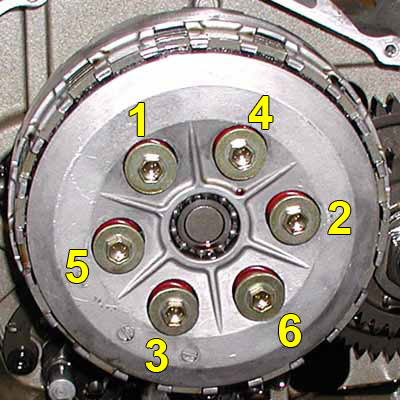
With the proper shims (if applicable) on each post put the springs and bolts back on and tighten them down slowly in a criss-cross pattern (like in the pic).
Once they are all close to being snugged down get out the torque wrench and finish them off by tightening them to 9 ft/lbs or 108 in/lbs. Be careful when you do this since you’re dealing with such a light amount of torque – many people have posted on the forums about breaking these bolts. I use an “old school” beam style torque wrench because I believe it is more accurate at low torque settings and so far I have never broken a single one of these bolts.
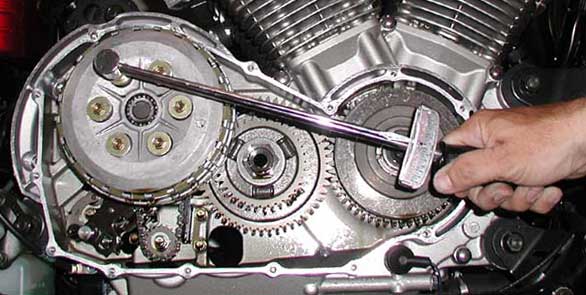
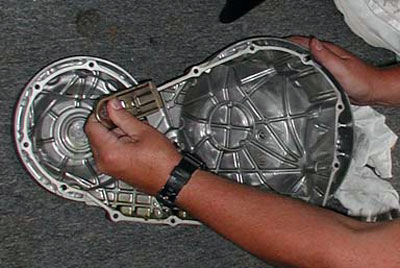
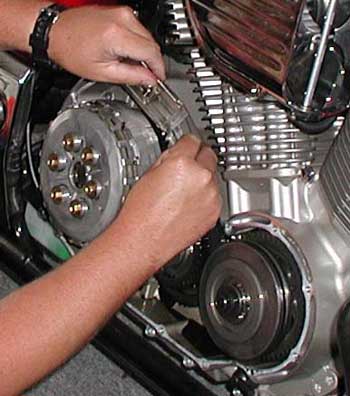
Once all 6 bolts are torqued properly you can begin the reassembly process. Begin by cleaning off both the case surfaces using a gasket scraper (available at auto parts stores for a few bucks and well worth it IMO). If you don’t have one, a razor blade will suffice. Scrape all the old gasket off and make sure both surfaces are clean.
|
|
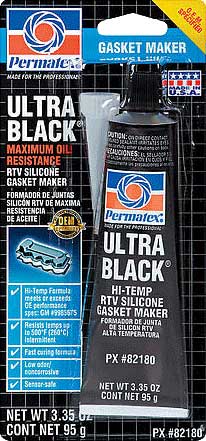
I usually wipe each surface with a little rubbing alcohol and a paper towel after scraping the gasket off, just being careful not to cut myself on the sharp edges. This isn’t completely necessary, but doing this ensures both surfaces are good and clean. Now get out the black RTV or “Hondabond” liquid gasket material and run a small consistent bead around the mating surface of the case cover that is removed. You don’t have to use a lot, remember that the cases are going to be bolted together so anything much thicker than a piece of paper is going to be squeezed out as extra. Just put a thin, even layer so that you end up with a nice seal all the way around. I use my finger afterwards to make sure it’s spread evenly and completely over all the edges. If you look closely at the cover you’ll see that it’s not necessary to do the “outer circles” around the timing and clutch covers where it is double-walled as there are small slots there anyway.
With the liquid gasket in place you can slide the cover back onto the case and begin reinstalling all 15 of the 8mm cover bolts again.
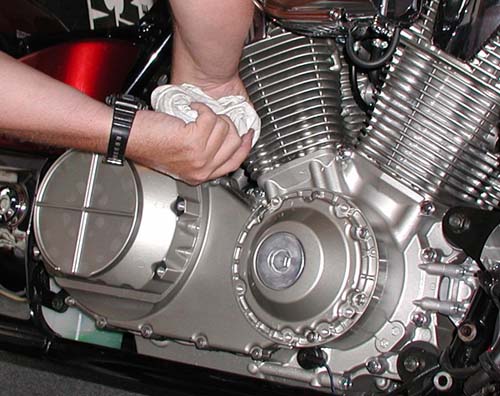
Torque the case bolts down to 9 ft/lbs or 108 in/lbs and then wipe up any gasket maker you may have squeezed out during this process. If you’re not in a hurry then don’t wipe the gasket off now, if you wait until it dries it will peel off very easily.
With the case cover bolted up you can reinstall the big rubber dampener and the chrome clutch cover using it’s seven 5mm bolts. Then reinstall the chrome timing cover using its five 5mm bolts. These only require a few ft/lbs of torque each so just be careful snugging these down normally and don’t wrench on them too hard.
That’s it, you’re done! The only thing left to do is to reinstall your exhaust system per whichever set of directions you need to follow, making sure to use new exhaust gaskets (pics below).
Rear exhaust port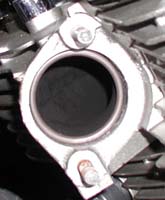
|
Front exhaust port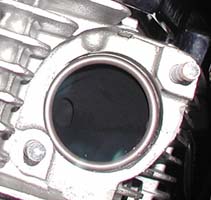
|
With the exhaust reinstalled remember to torque the 12mm exhaust nuts to 17 ft/lbs. Go back over them several times as some will “loosen” a bit as you snug the others down. Make sure to re-torque these again after a couple of rides as the heat/cold cycle of riding will tend to loosen things up a little bit as well. If you drained your oil don’t get over-excited and forget to put BOTH your drain plugs back properly (22 ft/lbs), install a new filter, and add 3.9 quarts of your favorite oil.
That’s it – you’re done – congratulations!
Afterthoughts
This is a swap that will be necessary at some point in time during ownership of the bike. The clutch is not a lifetime component on these bikes, especially since many stock clutches slip even when they’re new. I opted to install the MTC clutch because in this particular application the bike needed the extra grab (it was running a 40 shot of nitrous). Sometimes a simple spring swap will be all that is needed to stop slipping on a stock bike, but if that doesn’t solve your problem then this may be your answer.
Some people will tell you it’s not necessary to replace the stock steel plates unless you are really having problems with the clutch, and sometimes this is true BUT… The VTX doesn’t do the best job at oiling the inner plates, so what you usually find when you open the bike is outer plates in good condition and inner plates burned up/glazed. So while you might be able to reuse some (possibly all) of the steel plates, do you really want to open the bike up and find that you need to replace them but don’t have them? Then you have to wait with your bike unrideable and the right case wide open while you order new steels and have to wait. My personal opinion is that it’s worth the ~$50 of “insurance” not to be stuck in that situation. Replacing the steels will also save you from having to do the job twice if you reuse the old plates and have problems later on.
With a friend around to help remove and reinstall the exhaust this isn’t a hard job to do. I figure it’s about an hour total for job time NOT including the exhaust removal and reinstall (some exhausts are a little tricky to get on/off).
Video courtesy of Big Bad
This video is intended to give you an idea for the kind of things you’ll see and do during this job. It is not intended to replace the above instructions for anyone except experienced mechanics because the text above contains important details.
This may be a dumb question but i was wondering which side of the bolt you put the shims on. Do you put it on the thread side under the spring or on the bolt head side on top of the spring? Thanks for your help awsome walk through you have made for us here!
Justin Noland
copy/pasted from above:
“With the proper shims (if applicable) on each post put the springs and bolts back on and tighten them down slowly in a criss-cross pattern.”
So Tassy when you read that how do you interpret that. As the shims go on the thread side of the bolt?
Great instructions.
Thanks
Bear,
Great Instructions, very detailed. Just follow exactly and even I can do it… I installed mine in Feb of 2011. Easy and the clutch just makes me smile.
I believe what the other gentleman was looking for is after installing the clutch plates (see picture inner plates/outer plates) you put up a statement he missed, “At this point reinstall the lifter plate over the clutch plates and prepare to install the springs and bolts.” Then you went on to enplane, “…You install one shim of each thickness on the bolt/spring posts after installing the lifter plate but before installing the springs and bolts.” You have had so much familiarization with the process, he was overwhelmed by the terminology. I knew what you were saying but, had to re read this part to understand the his question fully. Thank you for the excellent write up. You gave us the knowledge to succeed while building the inspiration in all of us. I will be doing mine shortly and you gave me the confidence that I can accomplish it as well. After reading the manual I got a little nervous. You calmed me right down. Thanks again! You saved me a lot of money.
Bought a brand new 2008 1800N spec 3 off the showroom floor with 0 miles in march of 2012 , and after a couple of days getting used to the power of this bike I started feeling a slip between 3 and 4th. The bike now has almost 7K on it and I have been preparing to do this for a few months, because it only does it if I get a hair up my tail to street race, then it irritates me when it happens. Outstanding directions and photo’s on this subject. Makes me feel like a know what I’m doing before I get there which was my point of researching in the first place.
The following is my opinion, and should be taken as such.
The MTC clutch locks up very well. Maybe too much, depending on the setup, for everyday driving, for stock & stage one,
(intake, exhaust,& fuel managment), bikes. IMO the MTC, (frictions, spring/shims) are for stage two & three racing
application. The Barnett steels (flat) will give more lock up.
While the OEM steels (dimpled) will not be as violint of a grab.If you do go with the MTC setup. Do youself a favor and
get the ( B&B heavy duty clutch bols and washers).I know the feeling of wanting to have all the parts on hand, before taking the bike appart. That being said.
If your X has never had the cluch done, or has an OEM setup, and it’s slipping a
little at times. For a STOCK, or STAGE ONE BIKE! That is ment to be an everyday ride. Get a set of Barnett springs.
Take x appart, and mesure everything! (7X Steels(Driven); Warpage Limit= 0.30mm/0.012″) (8X (Friction(Drive); thickness; new 3.72mm-3.88mm/0.146″-0.153″, limit=3.10mm/0.1220472″) (6X Springs; new 58.2mm/2.29″ , Limit 56.7mm/2.23″) Chances are that your frictions, & steels are good, and the springs are beyond the sevice limit.
Use the Barnett springs and you should be all set! If a friction, or steel is beyound service limit, close to it, or blue burnt.
Replace (as a set) with OEM parts, or- (Barnett; 6 Carbon-fibers/center, 2 Kevlar-fibers/ 1 in & 1 out, HD Springs)
(Honda OEM; Steels) (BigLry&Bones; HD Bolts & Washers).
Thanks goes to BigLry, Bare, Bones, and all who have made “Bareass Choppers”, the goto place for VTX info!
I’ve done 24 of these “Maintenance & Tech’s”. All are good! If it wasn’t for you guys. My X wouldn’t be what it is today! , A 13 year old bike, running better, & more reliable than new!
Thank You!!!!
“Torque the case bolts down to 9 ft/lbs or 108 in/lbs and then wipe up any gasket maker you may have squeezed out during this process.”
Am I missing something here or does the VTX1300 Manuel call for these case bolts to be torqued to 20 ft Lbs?
Torque them to 20 ft/lbs and you’ll break them (or get really close). I’m not sure where the manual says 20 ft/lbs for case bolts but my guess is that it’s referring to the larger bolts that hold the case together.
I located it on Motorcycle Torque Specs on your website per Honda 03-09 VTX 1300 factory manual- General Information- Torque values- page1-10-Crankshaft/Transmission-Right Crank Case Bolt-16 each-Thread Dia 8 MM-Torque 26 Nm, 27 Kgfm, 20 lbf-ft.
It does sound high to me, so I will use the 9 lb-ft since you have had success with it.
Yeah, that’s not the proper bolts. I understand the confusion, but those specs refer to the sixteen 8mm bolts that hold the entire left crankcase to the motor. This article, written for the 1800, covers fifteen SIX mm bolts and your 1300 has 16 SIX mm bolts. The head of the bolt is 8mm but the actual size of the bolt is 6mm (as the manual would state it) because bolts are sized by the threads, not by the heads. So your 20 ft/lb value from the specs is for a larger bolt with 8mm -threads- (and a 10mm head) that can handle 20 ft/lbs of torque. Make sense?
If you have a complete manual for the 1300, open to chapter 11 and within the first couple of pages they will have a picture showing the actual case bolts we’re referring to. They are inside this cover, you can even see a couple of them in the pictures above.
Hey Bare,
I followed your instructions for installing a new clutch kit in my 1300C. All I can say is thanks. You laid it plain and simple.
Between your instructions, the odd reference to the manual and the video you linked, it covers it all.
Thanks for posting this.
Greg
I use those magic eraser pads or the generic about everywhere around the hose and I tried it for gasket removal..very pleased, rinsed with gas then wiped with alcohol. Good read, but I’m on to find tips for installing the clutch plates, discs, judder spring,spring seat and center as a SET on my 03 Honda ACE VT750. Thanks for the tips.
Thanks for instructions. Very detailed and very much appreciated. Funny thing when I went to reinstall the spring bolts I carefully started each by hand. Evenly worked them in , in a crisscross pattern and before I could even get close to setting the spring collars on the center post a bolt head came off. A second head broke off while removing the other bolts. After extracting broken bolts, ordering new replacements, I did some torque testing samples before attempting to install new bolts. Installed the new screws using a screwdriver style nut driver to seat the collars then used torque wrench to finish. Still believe old bolts were the problem.
I have an unlimited supply of SPROCKET, OILPUMP DRIVE(31T)
15131-MCH-000. If you need one go to ebay and search for 151-MCH-000(R).
Thanks